On This Page
Overview
Is Mental Health a Disability in Canada?
Mental Health Conditions That Qualify for LTD
Why Did Your Mental Health LTD Claim Get Denied?
Denied or terminated LTD benefits? Your legal options
How Do Insurers Investigate Mental Health Claims
What to Do If Your Mental Health LTD Claim Is Denied
The 2 Year Change of Definition for Mental Health LTD
Examples of Canadian Mental Health LTD Cases
How MacGillivray Disability Law Can Help
Speak to a Disability Lawyer About Your Mental Health LTD Claim
Hear from our clients
Frequently Asked Questions
Talk to Our Long Term Disability Lawyers
Overview
Living with a mental health condition while trying to navigate an insurance claim can feel overwhelming. If your claim has been denied, delayed, or cut off, you may be exhausted, frustrated, or unsure where to turn. You are not alone, and you have options. At MacGillivray Disability Law, we help Canadians across the country fight unfair denials and secure the long term disability benefits they deserve. We understand what you are going through, and we are here to take the pressure off your shoulders.


Talk to Our Long Term Disability Lawyers
On This Page
Overview
Is Mental Health a Disability in Canada?
Mental Health Conditions That Qualify for LTD
Why Did Your Mental Health LTD Claim Get Denied?
Denied or terminated LTD benefits? Your legal options
How Do Insurers Investigate Mental Health Claims
What to Do If Your Mental Health LTD Claim Is Denied
The 2 Year Change of Definition for Mental Health LTD
Examples of Canadian Mental Health LTD Cases
How MacGillivray Disability Law Can Help
Speak to a Disability Lawyer About Your Mental Health LTD Claim
Hear from our clients
Frequently Asked Questions
Is Mental Health a Disability in Canada?
Yes. Depression, anxiety, and many other mental health conditions are legally recognized as disabilities in Canada and most insurance policies. If a mental illness substantially limits your ability to work, you may qualify for long term disability benefits under your insurance policy.
You do not need a physical injury to qualify. What matters is whether your symptoms prevent you from performing your job duties consistently and safely.
Mental Health Conditions Commonly Involved in LTD Claims
Depression
Major depressive disorder, persistent depressive disorder, and postpartum depression can all qualify when symptoms such as low energy, hopelessness, concentration loss, or suicidal thoughts interfere with your job duties.
Anxiety Disorders
Generalized anxiety disorder, panic disorder, and social anxiety may qualify when symptoms like panic attacks, avoidance behaviour, or chronic worry make work impossible.
PTSD (Post Traumatic Stress Disorder)
PTSD often qualifies for LTD, especially for first responders, military veterans, healthcare workers, and victims of trauma. Symptoms include flashbacks, hypervigilance, and emotional numbing.
Bipolar Disorder
Bipolar I and II can qualify when manic, hypomanic, or depressive episodes prevent consistent work performance.
OCD (Obsessive Compulsive Disorder)
OCD may qualify when intrusive thoughts and compulsions disrupt your ability to focus or complete tasks.
ADHD
Adult ADHD may qualify when symptoms such as inattention, executive dysfunction, and impulsivity make it impossible to meet job demands, even with treatment.
Burnout and Stress Related Disorders
Severe burnout, adjustment disorder, and chronic stress may qualify when they lead to clinical symptoms that prevent you from working.
Other Conditions That May Qualify
-
Schizophrenia and psychotic disorders
-
Personality disorders
-
Trauma related conditions
-
Substance use disorders (addiction)
-
Autism spectrum disorder
These conditions may qualify for LTD when they significantly limit your ability to perform your job duties, not based on diagnosis alone.
If you have been diagnosed with one of these conditions and your insurance company has denied or terminated your benefits, you have options. Below, we walk through why claims get denied, how to strengthen your case, and what to do next.
Why Did Your Mental Health LTD Claim Get Denied?
Mental health LTD claims are denied more often than physical injury claims because symptoms cannot be measured with X rays or blood tests. Common denial reasons include:
-
Insufficient objective medical evidence
-
Inconsistent or inadequate treatment
-
The insurer claims you are capable of modified work
-
No specialist (psychiatrist) involvement
-
Symptoms do not match the diagnosis
-
The insurer claims you can work in another occupation
-
Surveillance footage that appears to contradict your claim
-
Social media activity used against you
A denial does not mean you do not qualify. It often means the insurer is protecting their bottom line. Our team at MacGillivray Disability Law is here to listen, review your situation, and help you understand your options.
Denied or terminated LTD benefits? Your legal options
Insurance companies set a high bar for mental health LTD claims. While approval is unique, focusing on these four areas can give your claim a stronger chance of success:
1. Get a Clear Diagnosis
A formal diagnosis from your family doctor is the starting point. A diagnosis from a psychiatrist or psychologist strengthens your claim significantly. Make sure your medical records clearly document:
- Your specific condition
- Your symptoms
- How long you have experienced them
- How they affect your daily life and ability to work
2. Show Consistent Treatment
Insurance companies frequently deny mental health claims by arguing that the claimant is not in active treatment. Strong treatment evidence includes:
- Regular family doctor visits
- Therapy or counselling (CBT, DBT, talk therapy)
- Psychiatrist appointments
- Medication trials and adjustments
- Support groups or specialized programs
You do not need every treatment, but you need consistent, ongoing care.
3. Prove You Cannot Perform Your Job Duties
Your doctor must clearly explain how your symptoms prevent you from doing your specific job. Examples include:
- Panic attacks preventing interactions like meetings and phone calls
- Concentration problems affecting safety-critical work
- Fatigue or low motivation making productivity impossible
- Emotional dysregulation disrupting team communication
- Cognitive symptoms affecting decision making
The connection between your symptoms and your inability to work must be clear.
4. Provide Strong Medical Documentations
Insurers rely heavily on paperwork. The more detailed, the better:
- Doctor notes and clinical records
- Psychological or psychiatric assessments
- Functional ability evaluations
- Complete medication history
- Statements from therapists or counsellors
- Records of any incidents at work related to your condition, such as breakdowns, leaves of absence, or accommodations requested
How Do Insurers Investigate Mental Health Claims
Insurance companies actively investigate mental health LTD claims. Knowing their tactics helps you protect your claim.

Surveillance
Insurers may hire private investigators to film you in public. They look for activity that appears to contradict your reported symptoms, such as running errands, attending events, or exercising.

Independent Medical Examinations (IMEs)
The insurer can require you to see a doctor of their choosing. These IME doctors are paid by the insurance company, and their reports often favour the insurer.

Social Media Monitoring
Photos of you smiling, travelling, or socializing can be used against you, even if posted from a good day. Lock down your privacy settings.

Records Requests
Insurers will request your full medical history, including records unrelated to your mental health claim. Anything they find can be used to dispute your claim.
What to Do If Your Mental Health LTD Claim Is Denied
If your claim is denied, take these steps right away:
- Hold off on filing an internal appeal. These appeals stay within the insurance company and often result in the same decision.
- Continue your treatment. Stopping treatment hurts your case.
- Document everything. Save all letters, emails, and call logs from the insurer.
- Tell your doctor about every symptom. Do not downplay how you feel.
- Speak to a disability lawyer before responding to the insurer.
A legal claim is usually faster and more effective than an internal appeal. However, taking legal action can feel intimidating, especially when you’re already dealing with so much. At MacGillivray Disability Law, we offer free consultations to help you understand your options, even if you’re not sure you’re ready to take action. Reach out anytime, we’re here to help.
The 2 Year Change of Definition for Mental Health LTD
Most LTD policies have a critical milestone at the two year mark:
First 2 years: You qualify if you cannot perform your own job.
After 2 years: You must prove you cannot perform any job you are reasonably suited for.
This change in definition is when many mental health claims get cut off, even when the person is still unable to work.
If your benefits were terminated at the 2 year mark, you may still qualify. A disability lawyer can challenge the termination.
Two Year Mental Health Cap
Some LTD policies also include a two year cap on mental health benefits. Read your policy carefully. If you are approaching this cap, get legal advice immediately.
Examples of Canadian Mental Health LTD Cases
The following are publicly available Canadian court decisions involving mental health and disability benefits. They are referenced here for educational purposes only.
Greig v. Desjardins Financial Security Life, 2019 BCSC 1758
In this British Columbia Supreme Court decision, the court found that Desjardins had mishandled the plaintiff’s LTD claim, causing serious financial hardship and mental distress over a 17 month period when benefits were wrongfully terminated. The court awarded $50,000 in aggravated damages and $200,000 in punitive damages, reinforcing that insurers and plan administrators can be held accountable when they fail their duty of good faith.
Past case outcomes do not guarantee future results. Each case is unique and assessed on its own facts. Court decisions referenced above are publicly available through CanLII.
How MacGillivray Disability Law Can Help
Insurance companies often deny mental health LTD claims by arguing the medical evidence is not strong enough. Because conditions like depression, anxiety, and PTSD cannot be measured with X rays or blood tests, insurers may rely on their own medical teams to dispute your symptoms. The right legal support can change the outcome.

Building the Strongest Possible Evidence
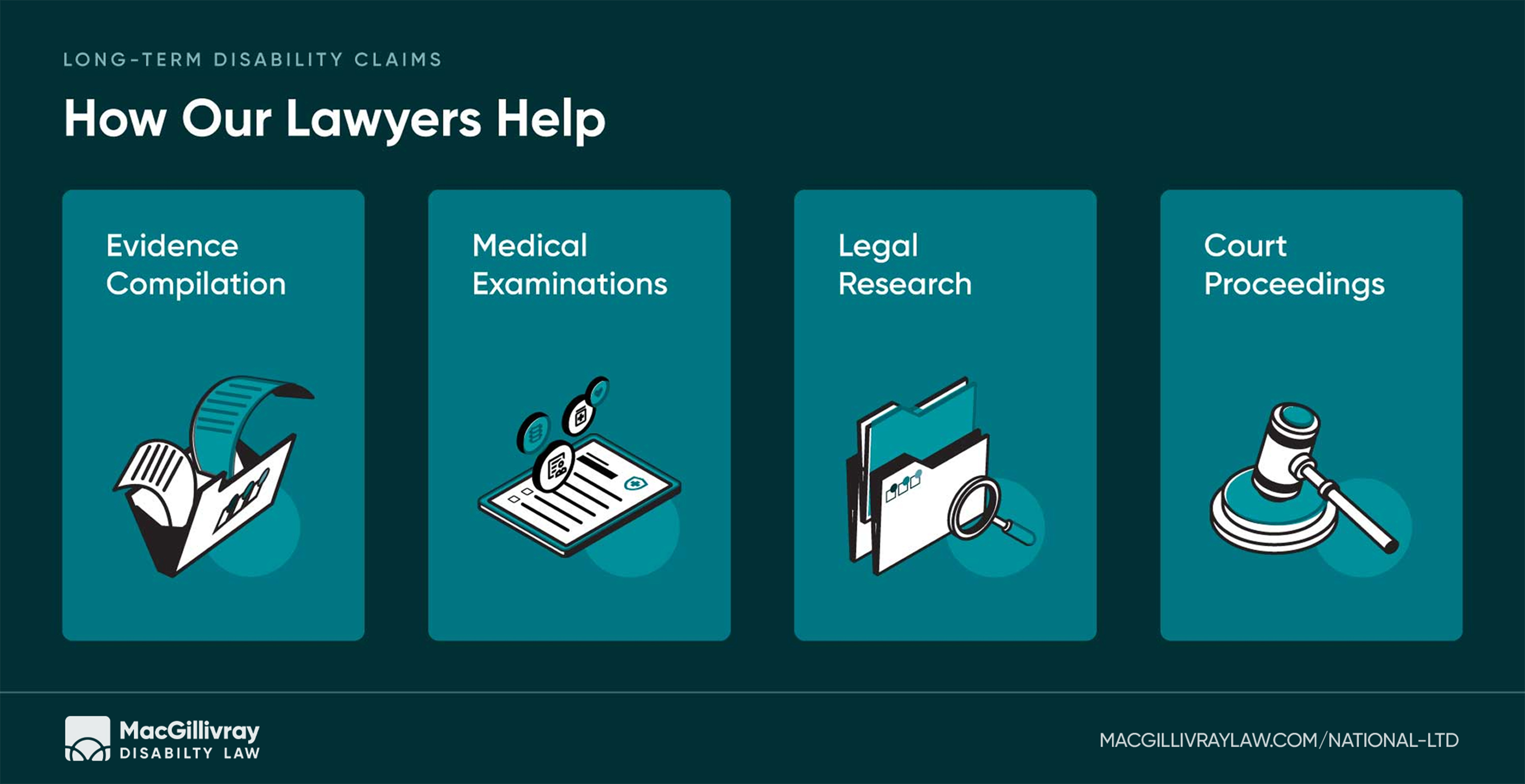
We know the right questions to ask your doctors, psychologists, and other healthcare providers to gather the documentation that insurers take seriously. Our goal is to make sure your claim accurately reflects how your condition affects your ability to work.
Connecting You with Trusted Specialists
When stronger medical evidence is needed, we connect clients with trusted specialists for Independent Medical Examinations. These assessments can provide the objective support that insurers often demand for mental health claims.

Interpreting Your Policy
LTD policies are full of technical language and fine print. We review your policy carefully, explain what it means in plain terms, and identify the rights and protections that apply to your claim.

Standing Up for You in Court
If your claim cannot be resolved through negotiation, we guide your case through the court process. We manage the deadlines, prepare the documents, and advocate on your behalf, keeping the process as clear and manageable as possible while pursuing the benefits you are entitled to.
Speak to a Disability Lawyer About Your Mental Health LTD Claim
If your long term disability claim for mental health was denied, delayed, or cut off, MacGillivray Disability Law can help. We have helped clients across Canada secure the benefits they are owed.
Hear from our clients
I spent 30 years being gaslit and dismissed by most medical professionals. Having dealt with so many who brushed me off, Steve’s compassion and understanding were a welcome reprieve from that negativity. He made me feel heard and seen, and he empathized with my situation on a deeper level than many of these so-called “medical professionals” ever did. I will always remember it. Thank you ❤️

Kathy Conway
4 months ago
After fighting for my rights I turned to MacGillivray law for help. My life was no longer my own. Years of fighting, debt and physical pain took a toll on me and my family. MacGillivray Law took on the fight. They gave me my life back! No more looking over my shoulder. No more worry. No more stress. I owe MacGillivray Law more than they will ever know. Thank you for giving us our future back! Our gratitude is endless!

Trevor Berringer
5 months ago
They are more than just lawyers. They didn't just handle my claim; they provided a lifeline, working tirelessly as if they were helping a broken person get back on their feet. Thanks to their professional and unwavering support, I was finally able to focus on my recovery. I am so grateful for their guidance and advocacy. They are more than just lawyers; they are truly compassionate advocates.

Sabiha Shahid
6 months ago
Frequently Asked Questions
Yes. Depression is recognized as a disability in Canada when it substantially limits your ability to work or perform daily activities. You may qualify for long term disability benefits if your depression prevents you from performing your job duties.
Yes. Anxiety disorders, including generalized anxiety disorder, panic disorder, and PTSD, are recognized disabilities in Canada. You can qualify for LTD if your anxiety prevents you from working consistently or safely.
Conditions commonly involved in claims include depression, anxiety disorders, PTSD, bipolar disorder, OCD, ADHD, schizophrenia, personality disorders, and substance use disorders. Eligibility depends on how the condition affects your ability to work, not the diagnosis itself.
To go on LTD for mental health, follow these steps: see your doctor and get a formal diagnosis, start consistent treatment, request claim forms from your insurer, submit forms with full medical documentation, and consult a disability lawyer if your claim is denied.
After 2 years, most LTD policies change the definition of disability. You must prove you cannot perform any job you are reasonably suited for, not just your own job. Many mental health claims are cut off at this point. A lawyer can help you challenge the termination.
Most insurers take 30 to 90 days to make an initial decision. Complex mental health claims often take longer. If denied, the appeal or legal process can take 6 to 24 months depending on the case.
You do not legally need a lawyer to file an LTD claim, but you should consult one if your claim is denied, delayed, or terminated. Mental health claims are denied more often than physical injury claims, and a lawyer significantly improves your chances of approval.